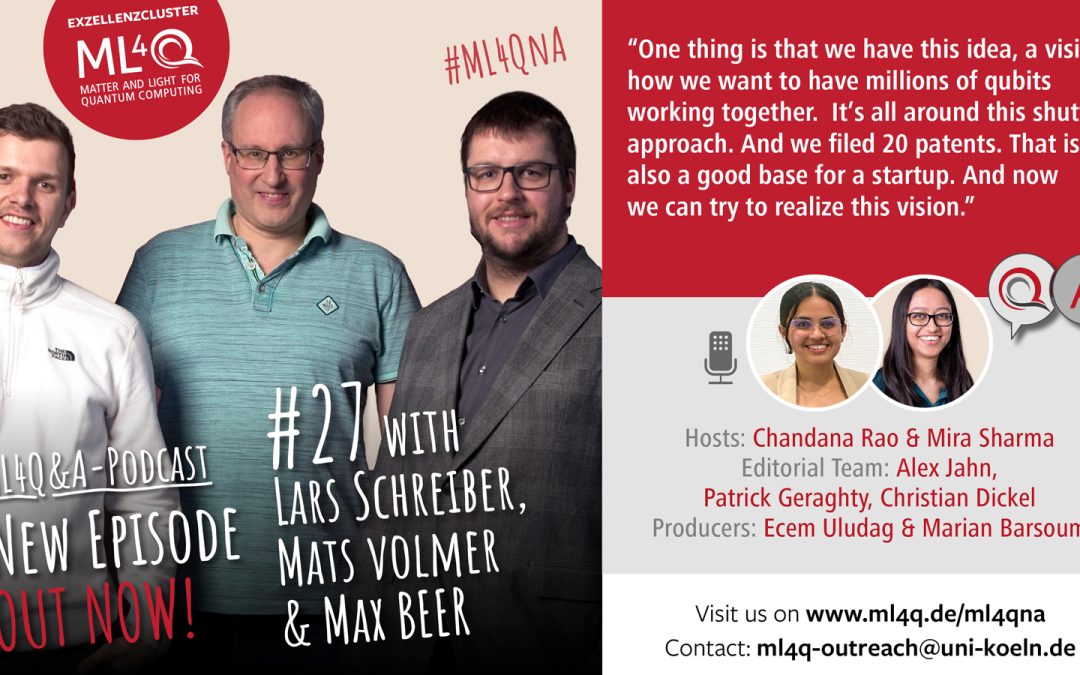
The conversation explores the practical realities of building spin qubit devices, from material imperfections and device variability to the difficulty of controlling millions of qubits. Mats and Max discuss their work on conveyor-style spin-qubit shuttling and T-junction architectures for routing qubits in two dimensions, explaining how moving electrons across a chip can enable scalable designs while introducing new challenges such as valley splitting and decoherence. They also discuss the surprising material physics that emerges when quantum informations starts to move.
The episode also examines how these research ideas are transitioning into real-world technology through the startup Arque Systems, highlighting the shift from academic prototypes to industrial-scale quantum hardware.
Listen to the full podcast episode with Lars Schreiber, Mats Volmer and Max Beer here or using your podcatcher.
0:00:04 Introduction & guest overview
0:02:04 Career journeys: from semiconductors to spin qubits
0:08:44 Life as an experimental quantum PhD student
0:11:32 Teaching quantum technology at RWTH Aachen
0:15:05 What is a spin qubit? Silicon vs Galium-Arsenide
0:21:01 Qubit encodings, scalability & conveyor-mode shuttling
0:31:38 Valley splitting: the key material challenge in silicon devices
0:43:05 Measuring spin states through coherent shuttling
0:52:18 T-junctions and 2D quantum routing architectures
1:05:31 From academic research to Arque Systems startup
1:09:26 Future outlook, lessons & advice for researchers
Previous ML4Q&A episodes:

Daqing Wang on Quantum Teleportation and Molecules as a Platform for Quantum Technology
In this episode of ML4Q&A, hosts Chandana Rao and Patrick Geraghty speak with Professor Daqing Wang, ML4Q Junior Professor of Experimental Physics at the University of Bonn, about his journey through experimental quantum science and the challenges of building...
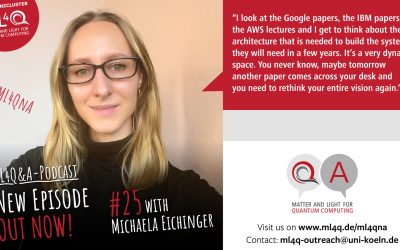
From PhD into the quantum industry: Michaela Eichinger on ML4Q&A
In this episode of ML4Q&A, Michaela Eichinger, Product Solutions Physicist at Quantum Machines and quantum content creator, joins Chris and Mira to discuss her journey from academic research to working in a deep-tech startup. Michaela reflects on the 2025 Nobel...

ML4Q&A Talks with Jens Eisert about Joining ML4Q, No-Go Theorems and Benchmarking
In this episode of ML4Q&A, Chris and Mira talk with Professor Jens Eisert, Professor of Quantum Physics at Freie Universität Berlin with affiliations at Helmholtz-Zentrum Berlin and the Heinrich Hertz Institute, and one of ML4Q’s new members for the next funding...

ML4Q&A Talks with Christine Silberhorn About Photonic Quantum Computing and Beyond
In this episode of ML4Q&A, host Mira Sharma, an associated member of the Matter and Light for Quantum Computing (ML4Q) Cluster, chats with one of the leading voices in experimental quantum optics - Professor Christine Silberhorn from the University of Paderborn....
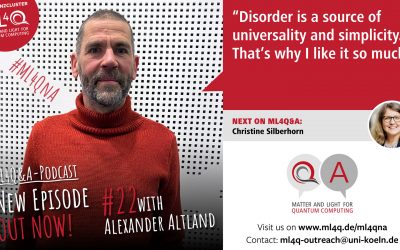
Concepts, Chaos, and Cluster Coordination: Alex Altland on ML4Q&A
In this episode of ML4Q&A, Chris and Mira talk with Alex Altland, theoretical physicist and ML4Q member, about the tension between deep scientific thinking and the administrative reality of coordinating the renewal proposal of ML4Q. As one of the designated...
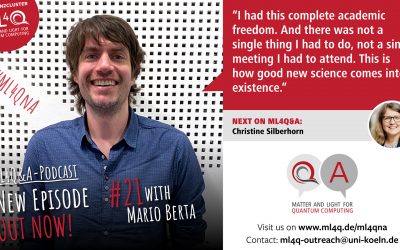
From industry back to academia: Mario Berta on MLQ&A
In this episode of ML4Q&A, Chris and Mira are joined by ML4Q Professor Mario Berta, who shares his unique journey from ETH Zürich via Imperial College London and Amazon Web Services to RWTH Aachen University. They discuss his work on quantum algorithms,...