
Observation of critical scaling in the Bose gas universality class
The emergence of critical behavior near phase transitions, where thermodynamic quantities and the spatial correlation lengths diverge, is a fundamental hallmark of statistical physics, famously manifested in classical phenomena like critical opalescence. In a recent work published in Science Advances, researchers from M. Weitz’s group at University of Bonn, in collaboration with J. Schmitt from Heidelberg University and a theory team at the National Autonomous University of Mexico, demonstrated that this critical scaling can be realized in a two-dimensional quantum gas of light. By confining photons in a dye-filled microcavity featuring a nanostructured soft-box potential, they thermalized the optical quantum gas to room temperature via radiative contact with dye molecules in the near absence of interparticle interactions. By extracting the first-order spatial coherence near the Bose-Einstein condensation phase transition, they observed an algebraic divergence of the correlation length, corresponding to a critical exponent of 0.52(4). These findings suggest that gases of light represent a distinct and overarching class of physical systems, opening up new avenues for quantum science and technology.
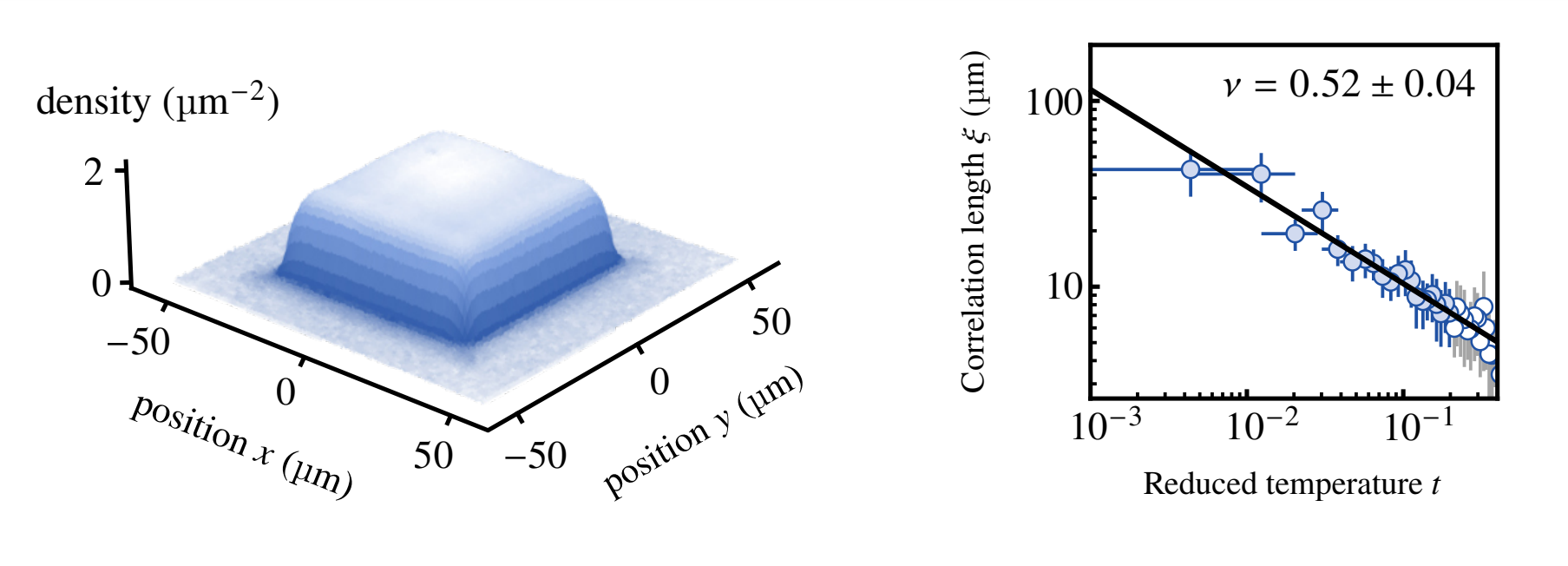
(A) Uniform surface density of a quantum degenerate photon gas in a box, (B) Correlation length as a function of reduced temperature displayed on a double-logarithmic scale, highlighting the signature of a power law scaling with a critical exponent of n =0.52(4).
Publication: Leon Kleebank et al, Observation of critical scaling in the Bose gas universality class.Sci. Adv.12,eaee2942(2026).DOI:10.1126/sciadv.aee2942
Discover more!
More ML4Q News