Pint of Science brings quantum research to Cologne pubs
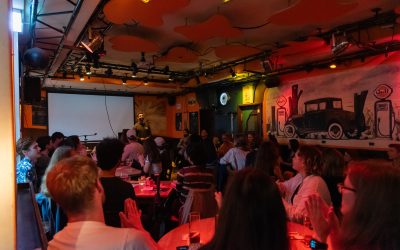
ML4Q was also part of each evening. The three talks showed how exciting quantum research can be when it is explained clearly and shared in an open setting.
The series began with Patrick Geraghty, Postdoctoral Researcher at Forschungszentrum Jülich. His talk focused on collective behaviour. How can many individual particles suddenly act together? And why do similar patterns appear in very different areas, from liquids to models of political opinion formation? One central idea was universality. It means that systems which seem very different at first can follow similar rules in certain situations. This made the talk not only about particles and motion, but also about a bigger question: why does physics find the same patterns in such different places? In this way, collective behaviour became a story about hidden order and unexpected connections.
On the second evening, the audience encountered a surprising connection. Aprem P. Joy, Postdoctoral Researcher at the Institute for Theoretical Physics at the University of Cologne, started with the question: What do animal colonies and quantum materials have in common?More than one might think. In both cases, many individual parts interact with each other. These interactions can create new patterns that cannot be understood by looking at just one part alone. This made the idea of collective behaviour easier to approach. It showed that collective effects are not only hidden deep in theory, but appear wherever many parts act together. And sometimes the path to quantum materials does not begin with formulas, but with a look at an animal colony.
The final talk was given by Selma Delić, Doctoral Researcher at Forschungszentrum Jülich. She took the audience into the world of quantum computing. There are many big promises around quantum computers: faster calculations, new technologies and maybe even solutions to problems that classical computers cannot solve. She also looked at the challenges behind the technology. Quantum computers are not magical supermachines, but highly complex systems where every detail matters. The message of the evening was clear: the hype may be loud, but the research behind it is often even more exciting.
Together, the three evenings showed that when quantum research leaves the lecture hall, it does not lose its depth. Instead, it becomes easier to approach, more lively and opens the door to new questions and surprising conversations.
Vorherige Events

Pint of Science bringt Quantenforschung in Kölner Kneipen
Pint of Science bringt Quantenforschung in Kölner Kneipen [dipi_image_gallery_child...

Pint of Science: Zukunftstechnologien auf der Bühne
Pint of Science: Zukunftstechnologien im RampenlichtZum fünften Mal in Folge fanden junge Foscher*innen aus Köln ihren Weg zur Bühne beim beliebte Wissenschaftsfestival Pint of Science – dieses Jahr in drei Kneipen der Stadt. Wie immer waren alle drei Veranstaltungen...
Pint of Science erweckt grundlegende wissenschaftliche Fragen in Kölner Kneipen zum Leben
Pint of Science erweckt grundlegende wissenschaftliche Fragen in Kölner Kneipen zum Leben Pint of Science, eine jährliche Veranstaltungsreihe der wissenschaftlichen Gemeinschaft in Köln, begann dieses Jahr am Abend des 13. Mai in der Lost Level Bar mit Vorträgen von...
Entdecke mehr!
Mehr ML4Q News