

Under the theme “The Road to the Quantum Computer,” this year’s Cologne Children’s University invited young participants on an exciting journey into the world of quantum technology. Students in grades 4 to 6 had the opportunity to experience how modern research works at the II. Institute of Physics at the University of Cologne. The workshop was organized and supported by Annika Kurzmann, Oliver Breunig, Alina Rupp, Dominik Hoborka, Cornelius Dietrich, Nicolas Georgopoulos, Sebastian Meures and Daniel Jansen.
At the beginning, Annika Kurzmann introduced the young participants to the basics of quantum physics in a short talk. She explained in an accessible way what quanta are, why they behave so differently from objects in everyday physics, and what role so-called qubits—the fundamental building blocks of a quantum computer—play.
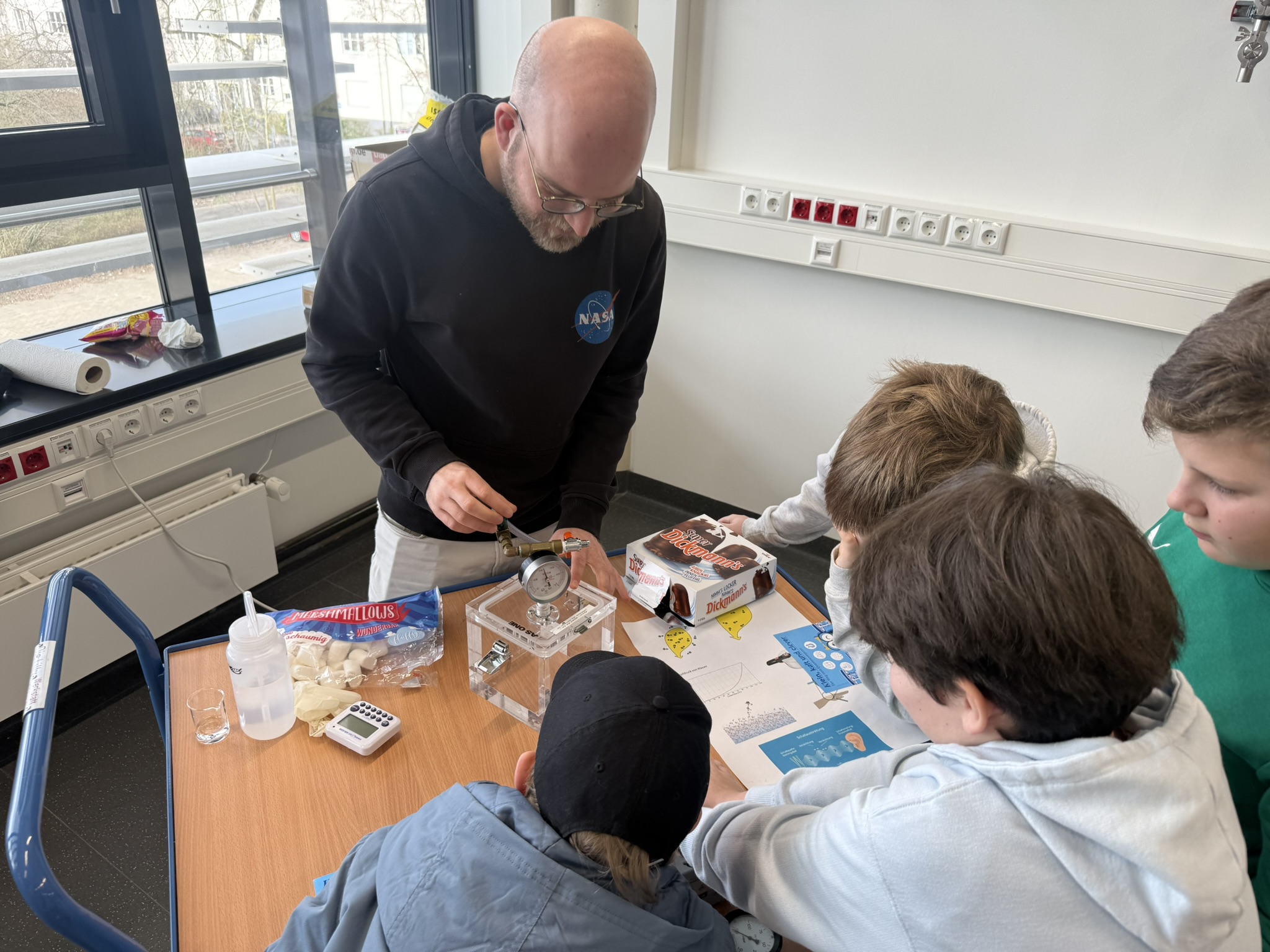
Afterwards, the workshop turned into a lively technology fair. At several interactive stations, the students could explore for themselves which technologies are needed to build a quantum computer. They learned how ultra-thin materials are produced, examined samples under a high-resolution microscope, and discovered why extreme cold, precise electronics, and sophisticated vacuum technology are essential for operating a quantum computer.
In this playful and engaging way, the participants gained insights into the fascinating world of qubits, the unique properties of quantum systems, and the technologies researchers are currently developing to make the quantum computers of the future a reality.
The Cologne Children’s University was founded in 2003 by the University of Cologne and is organized as a joint project of several Cologne universities and scientific institutions that are part of the Cologne Science Round (Kölner Wissenschaftsrunde, KWR). Through this collaboration, the Children’s University offers a diverse program each year for children in grades three to six—from exciting lectures and interactive workshops to longer-term projects.
Highlights from the Cologne Children’s University