
In this episode of ML4Q&A, hosts Chandana Rao and Patrick Geraghty speak with Professor Daqing Wang, ML4Q Junior Professor of Experimental Physics at the University of Bonn, about his journey through experimental quantum science and the challenges of building cutting-edge quantum technologies. Wang reflects on his early experience contributing to a landmark experiment that demonstrated quantum teleportation over 143 kilometers between the Canary Islands, describing what it was like to join such a high-impact project as a master’s student and the practical challenges involved in detecting fragile quantum signals over long distances.
The conversation explores the realities of running demanding quantum optics experiments, from dealing with noise and imperfect equipment to designing reliable single-photon sources using molecules trapped in microcavities at cryogenic temperatures. Wang also discusses the importance of interdisciplinary collaboration, particularly between physicists and chemists, in identifying and engineering molecules suitable for quantum devices.
Looking ahead, the episode considers how new tools, including artificial intelligence, could help design better quantum materials and accelerate the development of future quantum technologies. The result is a wide-ranging discussion about the past, present, and future of experimental quantum research.
Listen to the full podcast episode with Daqing Wang here or using your podcatcher.
00:00:00 Intro
00:02:10 Quantum Teleportation over 143 km
00:06:15 Scaling quantum communication experiments
00:07:44 Technical challenges in long-distnace quantum optics
00:13:00 The reality of running experimental physics lab
00:22:34 Single-photon sources with molecules
00:26:16 Why molecules are promising quantum emitters
00:32:07 Collaboration between Physics and Chemistry
00:39:41 Molecules and AI in quantum research
00:41:08 Reflections and outlook
Previous ML4Q&A episodes:
New podcast episode with Julian Schmitt
In the podcast's last episode in 2023, Chris talks to ML4Q member, Julian Schmitt, leader of the junior research group “Quantum fluids of light” at the University of Bonn. Julian recently received an ERC Starting Grant, the ML4Q Independence Grant. In 2022 he...
ML4Q&A with Steven Koester – listen to our first external guest from the Global Quantum Leap program!
We are excited to have our first external guest on the show. Steven Koester, Professor of Nanotechnology in the Department of Electrical and Computer Engineering at the University of Minnesota, is joining us mainly as the Director of the Global Quantum Leap...
Erwann Bocquillon speaks on ML4Q&A
One central milestone in the cluster's mission is the attraction of excellent young talents in the highly dynamic field of quantum computing. This was achieved in the last few years by the establishment of several professorships at all cluster sites. Newly...
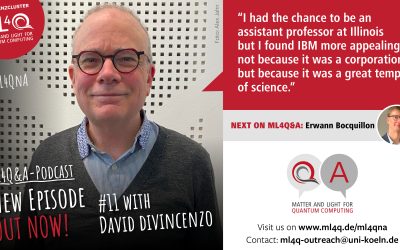
Insightful conversation with David DiVincenzo in ML4Q&A’s latest episode – tune in now!
In our latest episode, we are thrilled to talk to David DiVincenzo, Director of the Institute of Theoretical Nanoelectronics at Forschungszentrum Jülich & co-founder of the Institute for Quantum Information which is a joint institute of RWTH Aachen and the...
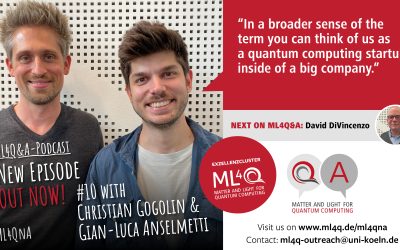
Tune in for our new podcast episode on quantum chemistry – with Christian Gogolin and Gian-Luca Anselmetti
We continue our new season by featuring members of the cluster who are working at the intersection with other stakeholders in the larger quantum community. In this episode, we talk to Christian Gogolin and Gian Anselmetti who are in-house scientists at Covestro and...
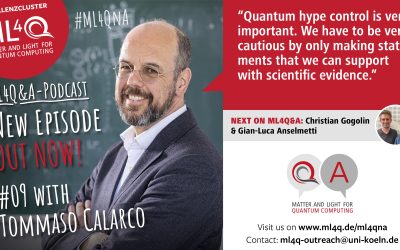
New podcast episode with Tommaso Calarco
In our new season we feature members of the cluster who are working at the intersection to other stakeholders in the larger quantum community. In this episode, we talk to Tommaso Calarco, Director of the PGI Institute for Quantum Control at Forschungszentrum Jülich,...