Soapbox Science Rheinland back in Cologne 2026
Anyone walking through Cologne on July 4 might have found themselves in the middle of cutting-edge research. Standing on simple wooden soapboxes in the city centre, female and non-binary researchers from ML4Q, CECAD and CEPLAS presented their work to the public. Despite the summer heat, passers-by stopped, listened, asked questions and joined the discussion.
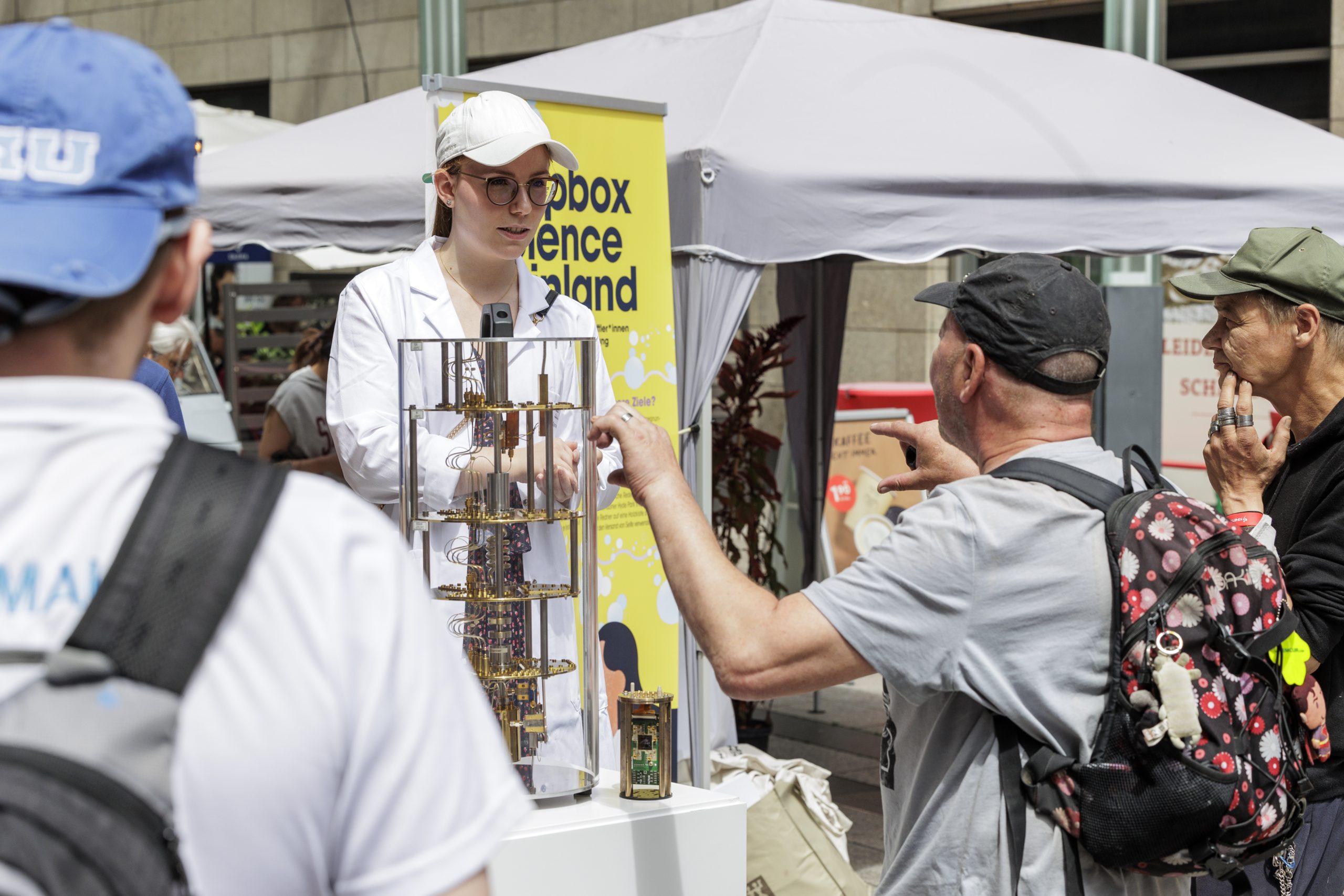
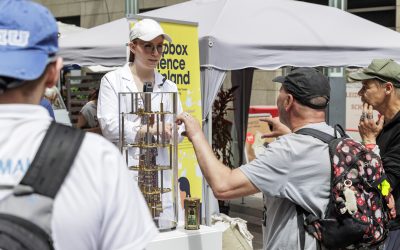
Among the speakers was ML4Q’s Isabelle Sprave, who introduced visitors to the Quantum Bus, or QuBus. A small group formed around her soapbox as she explained how it could connect different parts of a quantum chip. She compared the QuBus to a microscopic highway, and showed why such connections are essential for building larger and more powerful quantum computers. Her talk soon sparked questions about quantum errors, scalability and the challenges that researchers still need to overcome.
Just a few steps away, visitors heard why bats are so interesting for ageing research and what scientists can learn from the unusual hearts of naked mole-rats.
Each soapbox opened up a new field of research. Moving between them meant travelling from quantum technology to plant science and the biology of ageing, making science not only accessible, but a shared experience in the heart of the city.
Shuttling electrons: a cool idea for quantum computing
Isabelle Sprave, another associated member of ML4Q, captivated the crowd with a model of a quantum computer, easily drawing the attention of pedestrians. In her PhD at RWTH Aachen University she researches on a Quantumbus (QuBus). It serves as a kind of highway for electrons on a quantum chip and allows to have more electrons on each chip. This is a necessary development to build large scale quantum computers in the future.
A soapbox is traditionally a wooden crate used for shipping dry goods like soap. In the 19th century, it became a platform for impromptu speeches by politicians, fostering informal political discussions in public spaces. The concept of Soapbox Science draws inspiration from this rich history, aiming to simplify and democratize scientific discourse.
Soapbox Science is an innovative public outreach event that began in London in 2011 and now takes place annually in more than forty cities across sixteen countries. The goal is to bring science directly to the people, making it accessible for all, and challenging the stereotype about who can be a scientist by providing a platform for female and non-binary researchers from various backgrounds.
Soapbox Science Rheinland is a local event in Germany organized since 2020 by a team of enthusiastic people from universities in the Rheinland-area: University of Bonn, Cologne and Düsseldorf.
Previous events

From the Lab to the Soapbox: ML4Q at Soapbox Science Rheinland
Anyone walking through Cologne on July 4 might have found themselves in the middle of cutting-edge research. Standing on simple wooden soapboxes in the city centre, female and non-binary researchers from ML4Q, CECAD and CEPLAS presented their work to the public. Despite the summer heat, passers-by stopped, listened, asked questions and joined the discussion.

Soapbox Science 2025
Soapbox Science 2025 in the heart of DüsseldorfOn 28th of June the Düsseldorf Rheinpromenade transformed into a vibrant space where science met curiosity. Soapbox Science Rheinland 2025 brought together twelve brilliant women researchers who stood on soapboxes to...
Take Your Science to the Streets
Take Your Science to the Streets Apply to Be a Speaker at Soapbox Science Rheinland 2025 in Düsseldorf Are you a woman, non-binary, or genderqueer person working in science?Are you passionate about your research in STEM?Do you love sharing your science...
Discover more!
More ML4Q News